
The EMC-SRC Relation
Scale separation between the quark (~GeV) and nuclear (~MeV) regimes holds extremely well, and explains the success of the IPM shell model in describing most nuclear dynamics. However, in 1983 it was discovered that this scale separation breaks down, in what is now known as the EMC effect. Over 40 years and 1000 publications later, the scientific community still has no widely accepted explanation, though only two primary mechanisms remain.
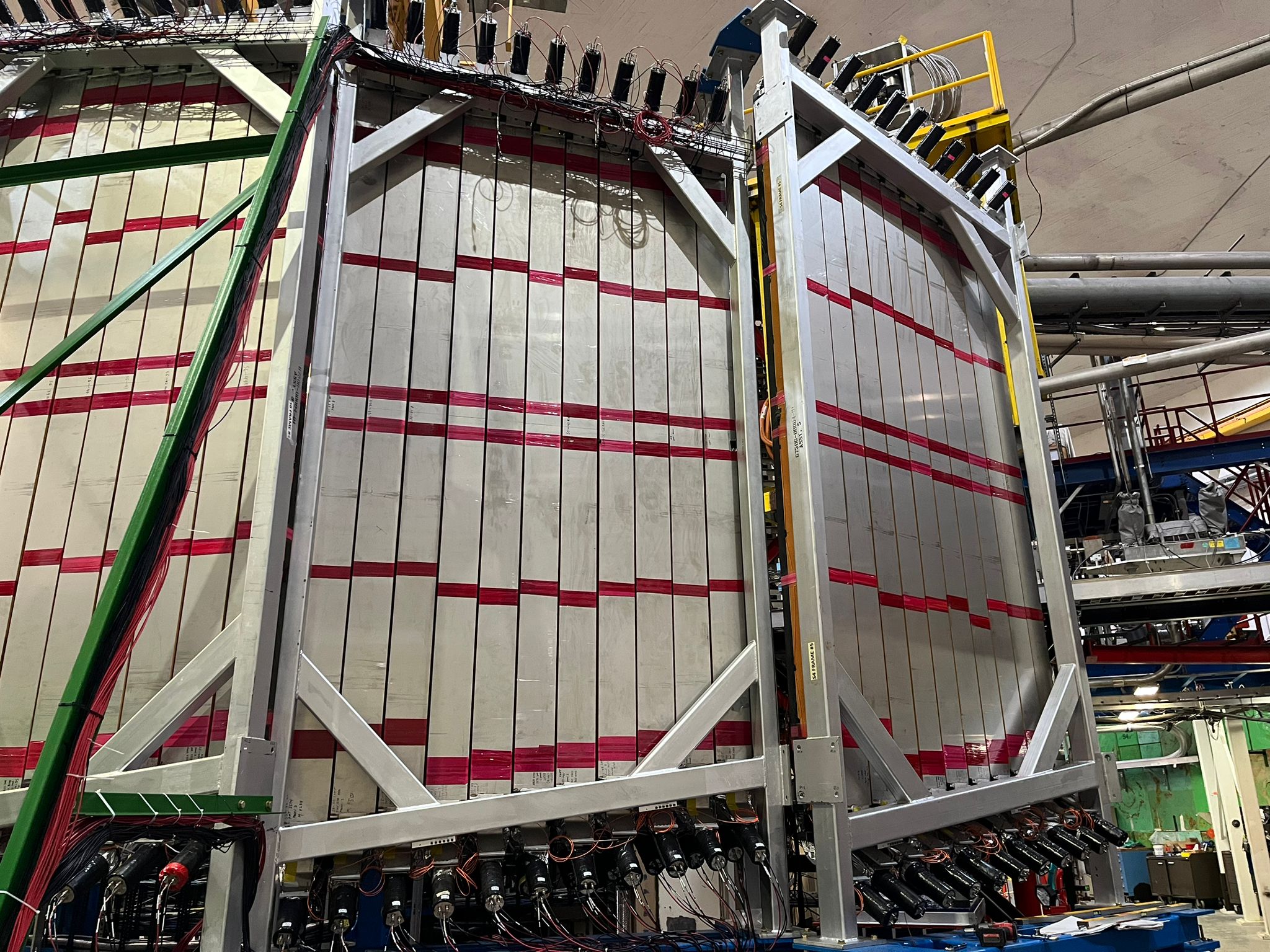
The Large Acceptance Detector experiment at Jefferson Lab aims to test one of these mechanisms—the EMC-SRC hypothesis, whereby the breakdown in scale separation occurs predominantly in high momentum proton-neutron pairs. If successful, this experiment could provide the first definitive answer to the >40-year old unsolved EMC Effect.
Detector and electronics installation timelapses
Photos
Relevant publications and Talks
Publications
F. Hauenstein, C. Ayerbe Gayoso, S. Ratliff, H. Szumila-Vance, A. Schmidt, L. Ehinger, O. Hen, et al.
European Physical Journal A (2024)
Talks
Workshop on Quantitative Challenges in SRC and EMC Research (SRC-EMC 2026) (2026), Berkeley, CA, USA
Hall C Winter Collaboration Meeting (2025), Newport News, VA
APS Division of Nuclear Physics Meeting (2024), Boston, MA, USA